
The new federal pay equity legislation aims to eliminate implicit gender discrimination in compensation policies and practices to ensure equal pay for work or equal value. This means that employees in female-dominated job classes should receive the same compensation as equivalent male-dominated job classes of comparable or equal value.
The Federal Pay Equity Act applies to all employers in ferally regulated industries having 10 or more employees. This includes public and private sector organizations operating in a wide range of industries such as telecommunications, postal services, interprovincial or international transportation, banking, interprovincial connections, grain handling, uranium mining and processing and radio and television broadcasting, federal public service organizations and crown corporations.
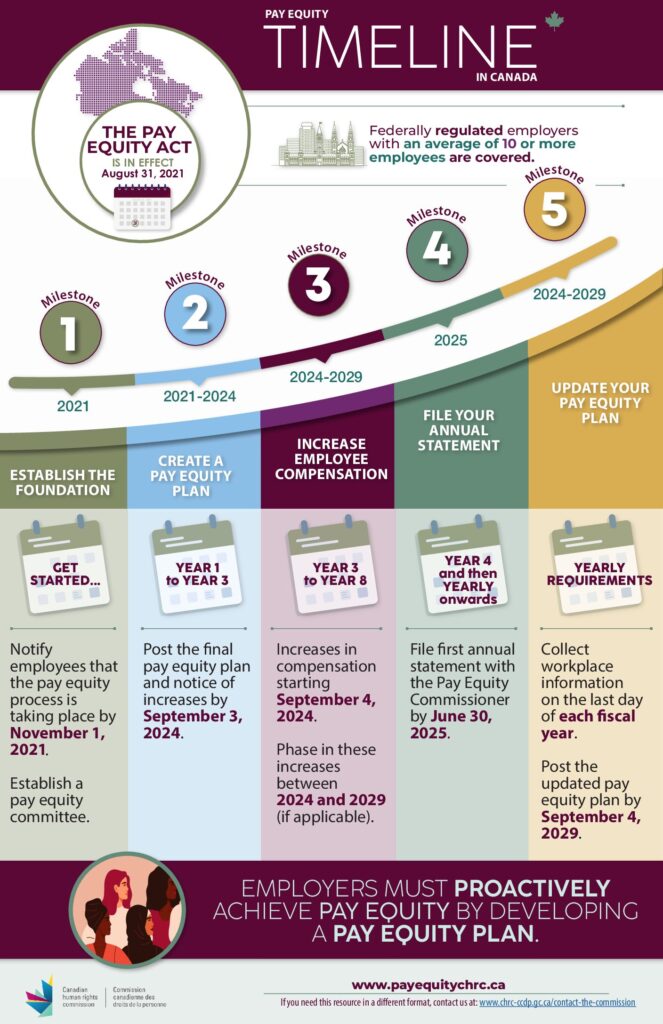
Employers active on or before August 31, 2021, must follow the standard deadlines listed in the Act.
- Employer’s Four Main Obligations
Obligation 1 – Develop a Pay Equity Plan Deadline: By September 3, 2024
Employers must create and post a draft pay equity plan, invite employee feedback for 60 days, and then post a final plan that incorporates those comments.
Obligation 2 – Correct Pay Gaps Deadline: By September 4, 2024, or the day after the final plan is posted.
Employers must increase compensation for female job classes where inequities exist.
Pay increases can be phased in if they exceed 1% of the previous year’s payroll, but interest will accrue on overdue payments.
Failure to meet deadlines or pay adjustments will result in interest charges.
Obligation 3 – File an Annual Statement Deadline: By June 30, 2025, and every year after at the same date.
Employers must report compliance progress and pay adjustments to the Pay Equity Commissioner.
Obligation 4 – Maintain the Pay Equity Plan Deadline: By September 4, 2029, and every five years thereafter.
The pay equity plans must be reviewed and updated regularly at least once every 5 years to ensure compensation gaps do not remerge over time. - Implementation Checklist and Resources
To ensure full compliance with the federal pay equity act, employers should:
Form a Pay Equity Committee if they have more than 100 employees or if some employees are unionized.
Facilitate the work of the pay equity committee by providing data, information and allocate time and effort to support the pay equity process.
Employers can use the tools and resources offered by the Canadian Human Rights Commission. Here is the link to the Commission’s tools and resources:
https://www.chrc-ccdp.gc.ca/resources